
Clearwater County Most Wanted: No List
The current Clearwater County Sheriff’s Office navigation did not reveal a county most-wanted page, active-warrant table, “warrant Wednesday” feature, local Crime Stoppers page, reward schedule, or photo-bearing wanted archive. That is a source finding as of August 18, 2026. It is not proof that Clearwater County has no warrants or that no agency maintains a restricted list.
Because no official list was verified, no responsible count, update cadence, photo policy, last-known-area field, reward rule, or anonymous-tip promise can be stated. A private page that labels a person “wanted” may mix old arrests, bench warrants, state fugitives, federal cases, and other counties. Use the sheriff and court channels for a specific question, and do not copy a private list as though it were a CCSO publication.
Photos stay with the responsible agency. No wanted image is rehosted here. The county’s official app offers tips and alerts, but its published description does not create a public wanted gallery.
Clearwater County Wanted Listing Fields
If CCSO later publishes a wanted page, read each field as a request for information, not a final statement about the person. The following table describes useful fields to check. At present, the county does not publish this schema.
| Possible field | Why it matters |
|---|---|
| Name or alias | Identifies the person as the agency records the name, but names can be shared. |
| Photo and descriptors | May help law enforcement compare an identity. A photo is not proof of guilt. |
| Warrant or case basis | Shows the stated process, charge, or case reference if legally public. |
| Warrant date or update date | Shows when a listing was made or reviewed. It does not prove it remains active. |
| Agency and contact route | Identifies where a tip should go and which office can confirm the status. |
| Reward or tip instruction | Must come from the agency. No Clearwater reward schedule was verified. |
Never publish a private address or try to locate someone yourself. If a county page appears later, save its exact URL and date, then call the listed agency before repeating a result.
Use the Clearwater County Wanted List
No verified local list is available to browse. If the sheriff's office posts one, or a state or federal page turns up a possible match, the workflow that follows will help.
- Open the official agency page from the county or state government domain. Check the page date, agency name, and warning language.
- Read the warrant or fugitive basis, not only the image. Record whether the entry concerns a warrant, state supervision, federal process, or a request for information.
- Do not approach, follow, message, or confront the person. A photo can be old, a name can be shared, and the status can change.
- Use 911 for an active emergency. For a non-emergency tip, use the CCSO published line or the official app’s tip channel.
- For the person’s later booking or case, use the Clearwater County records path and iCourt. A match is not a conviction and does not prove current jail custody.
For a full picture, start with the Clearwater County booking and records path. It shows how to line up a possible booking against custody records, court files, and state data.
Clearwater County Warrant Check
Start any warrant check with Idaho iCourt. It gives the public a state-court case search. Just know its limits. It is not a live, all-in-one warrant database. When a case is open to public view, a warrant-related event may appear in the register. Sealed or restricted cases usually stay hidden. The same goes for warrants that are unfiled, newly issued, recalled, or held up for administrative reasons. So a name search that comes back clean does not prove the coast is clear. Treat it as one clue, not the final word.
- Search Idaho iCourt with the exact name or case number. Narrow to Clearwater County and the Second Judicial District when the interface permits.
- Read the register of actions and record the case number, date, and event. Do not treat a category label as proof that a warrant remains active.
- Call the Clearwater County Clerk of the District Court at 208-476-5615 for court-record routing. The directory lists the clerk at 150 Michigan, Room 201, Orofino, Idaho 83544.
- Contact CCSO at 208-476-4521 or dispatch@clearwatercounty.org for the law-enforcement side of a specific question. Ask which office can confirm the status.
- If the question concerns you, contact an attorney or the court. Do not use a public search to evade law enforcement or to plan a self-surrender without advice.
The iCourt public-search tutorial walks through the portal's search mechanics and explains what public files can and cannot show. A third-party "warrant" hit is only a lead. Verify before acting on it.
Clearwater County Warrant Types and Custody
The word “warrant” can hide several different situations. A person can be wanted and not in Clearwater County Jail. Someone booked on a warrant may be released, transferred, or held on separate allegations.
| Term | Plain meaning | What it does not prove |
|---|---|---|
| Active warrant | A court or law-enforcement process that may authorize arrest. | It does not prove current custody or guilt. |
| Bench warrant | A court-issued process often tied to a missed court obligation. | It does not show that a person is on a public wanted list. |
| Warrant booking | An intake event after an agency brings a person to jail. | It does not settle the underlying case. |
| Wanted or fugitive listing | A public request for help locating a person. | It does not show the person is in any jail. |
| Release or transfer | A change in custody after booking or an alert event. | It is not an acquittal or dismissal. |
Clearwater County Tip Channels and Safety
The CCSO mobile app is the county's main tip channel. Tips stay anonymous. The same app takes non-emergency reports, posts news releases, and sends emergency alerts. No Crime Stoppers reward page, reward amount, or stand-alone local tip program exists for the county. Treat the app's own description as the full picture. Anything beyond that is guesswork.
Clearwater County Sheriff’s Office
Non-emergency and records route
208-476-4521
dispatch@clearwatercounty.org
Emergency response
Seeing a crime happen or facing immediate danger? Call 911 right away. A wanted listing is never a reason to approach anyone yourself.
The sheriff's official app page spells out the tip and alert tools the agency built. It is not a mugshot search, and it does not promise one.
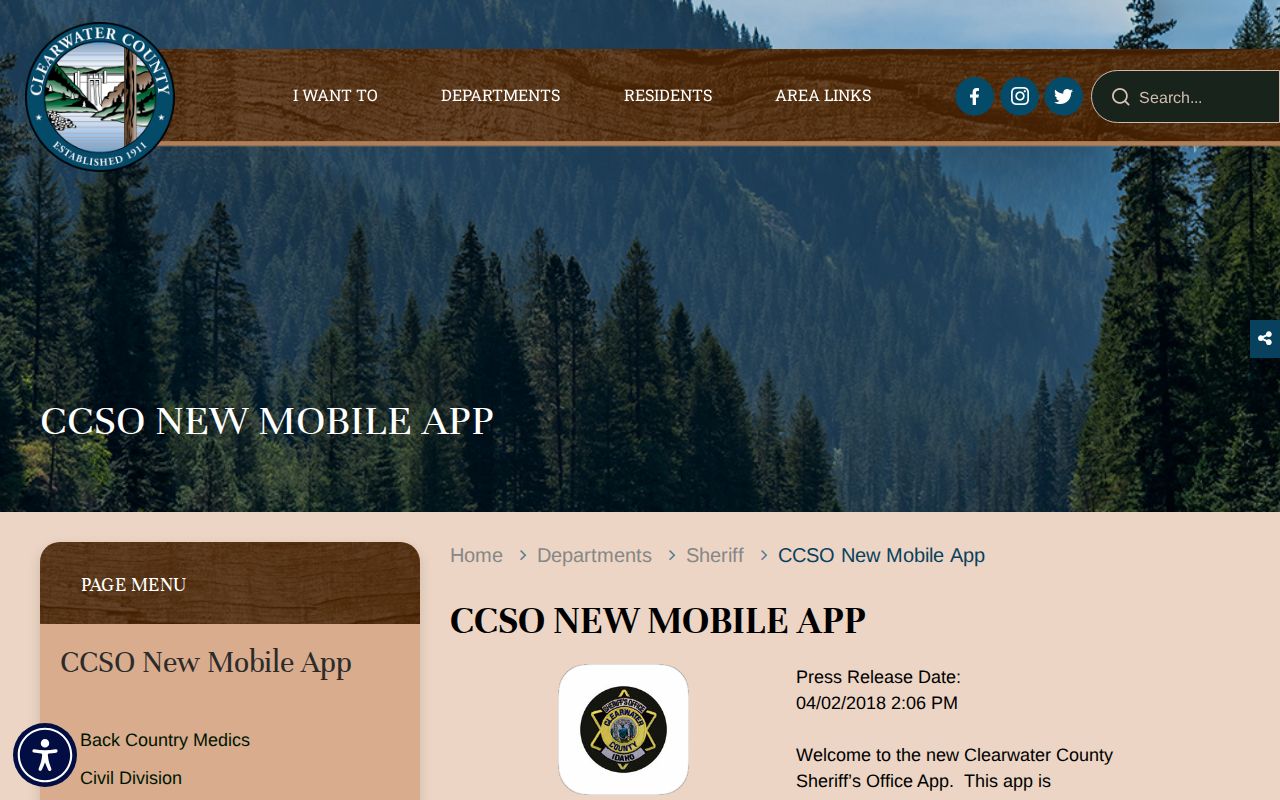
Let the app do what it does: take tips and push alerts. For a warrant status, contact CCSO or the court directly.
Online listings create temptations. Resist them all. Do not attempt a citizen's arrest, tail a wanted person, post a private address, or confront anyone named on a page. Pass what you know to law enforcement and let them handle it. That single step keeps you safe and puts the information in trained hands.
Clearwater County and Federal Wanted Resources
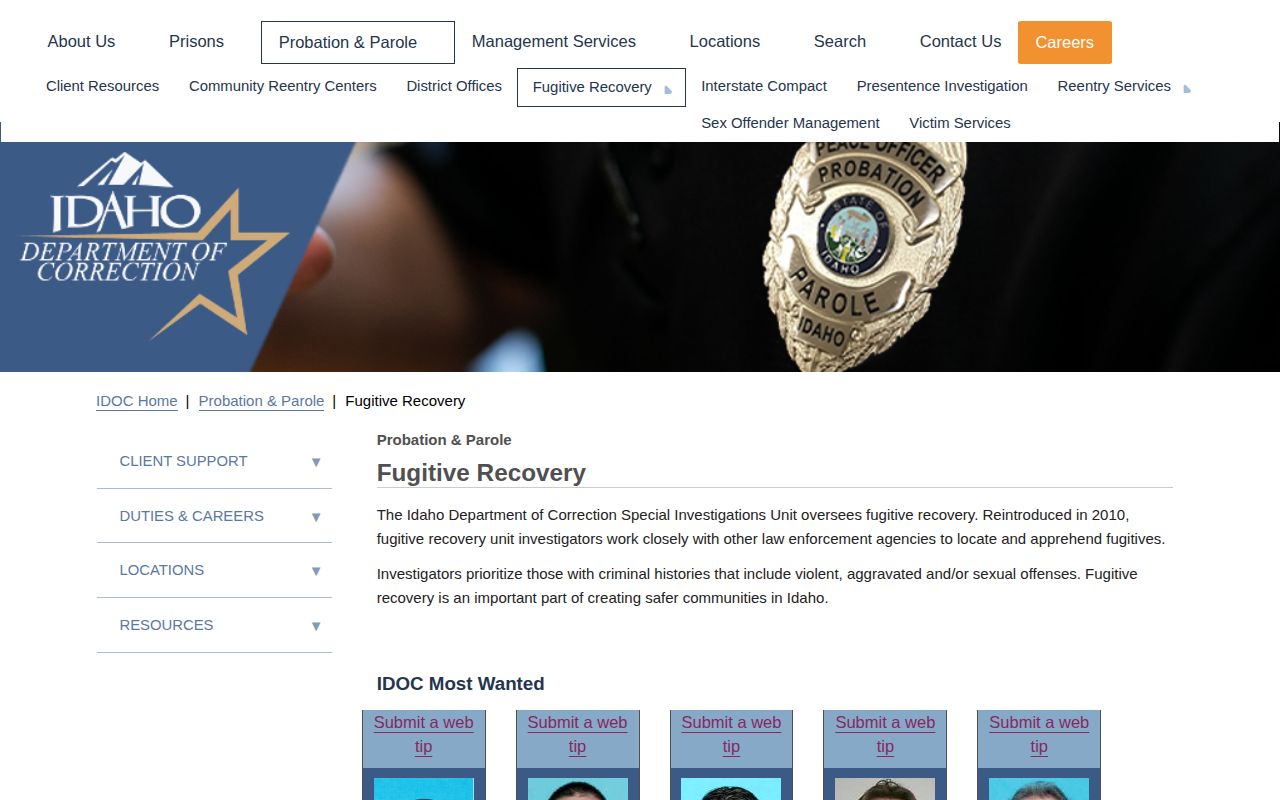
The Idaho Department of Correction Fugitive Recovery page tracks a different category of fugitive. It lists people wanted for violating state supervision. Many entries include photographs and instructions for submitting tips. Think of the state page as its own universe of wanted listings. It stands separate from anything booked recently at the county jail.
Federal tools fill a different gap. The Bureau of Prisons Inmate Locator finds people in sentenced federal custody going back to 1982, though it shows no public mugshots. The U.S. Marshals Service holds many federal pretrial detainees through local contracts, and it offers no public locator for them. Its photo policy keeps release rare. None of these federal sources substitute for checking the Clearwater County Jail roster.
What Clearwater County Publishes Instead
Clearwater County puts its official digital effort into communication and custody alerts, not a wanted gallery. The sheriff's site connects visitors to the jail, VINE, local news, a public-records form, and the Clearwater County Sheriff ID app. That app handles non-emergency reports, anonymous tips, public-safety updates, and emergency notifications. It offers no name search, warrant list, booking date, bond field, or mugshot.
Each channel covers one slice of the picture. The sheriff's news archive may post a public-safety release, though it stops far short of a full warrant or booking roster. VINE flags a participating release or transfer. iCourt shows public case events, and CCSO will route a specific law-enforcement question. Together they answer more than a copied wanted page ever could, while keeping custody status in plain view.
Treat the missing gallery as a local policy fact. It is not a gap for an unofficial list to fill. If the county ever adds a wanted page, check who owns it, when it was updated, how corrections work, and where tips go before trusting it.
How to Resolve a Clearwater County Warrant
Suspect a warrant has your name on it? Take a private, direct route rather than a public one. Public searches can miss restricted or newly issued entries. Third-party pages get things wrong too. Don't test the result by walking up to an officer or anyone else. That path carries risks no search result justifies.
- Gather the exact name, date of birth if known, case number, and county or court tied to the question.
- Search iCourt for public case events, then write down the case number and date of any warrant-related entry.
- Call the Clearwater County clerk at 208-476-5615 for court-record routing and CCSO at 208-476-4521 for the law-enforcement side.
- Ask an attorney or the court what action is appropriate when the question concerns the requester’s own status.
- Use the official surrender or court process provided by the responsible office. Do not rely on a private mugshot result as a plan.
Warrants have several possible endings. One can be recalled, quashed, transferred, or folded into another case. A later release or booking does not close out the underlying charge by itself. So let any public result point you toward a verified office, never toward a confrontation. That is the whole trick to using these records safely.
Clearwater Wanted Records Are Not Convictions
A wanted listing describes legal process in motion, nothing more. It might rest on a warrant, a supervision violation, or a simple request to locate someone. The picture can shift afterward as a case moves through court.
Read custody labels alongside every result: wanted, possible warrant, just booked, in county custody, released, transferred, sentenced to IDOC, or federal custody. Labels like these keep a name or photo from carrying more weight than the source supports.
Need a current Clearwater booking or photo? Head back to the countywide official records and custody path, which lays out the missing roster, the CCSO form, VINE, iCourt, and the state DOC handoff without inventing a wanted gallery.